time zone will be applied.
Report this post?
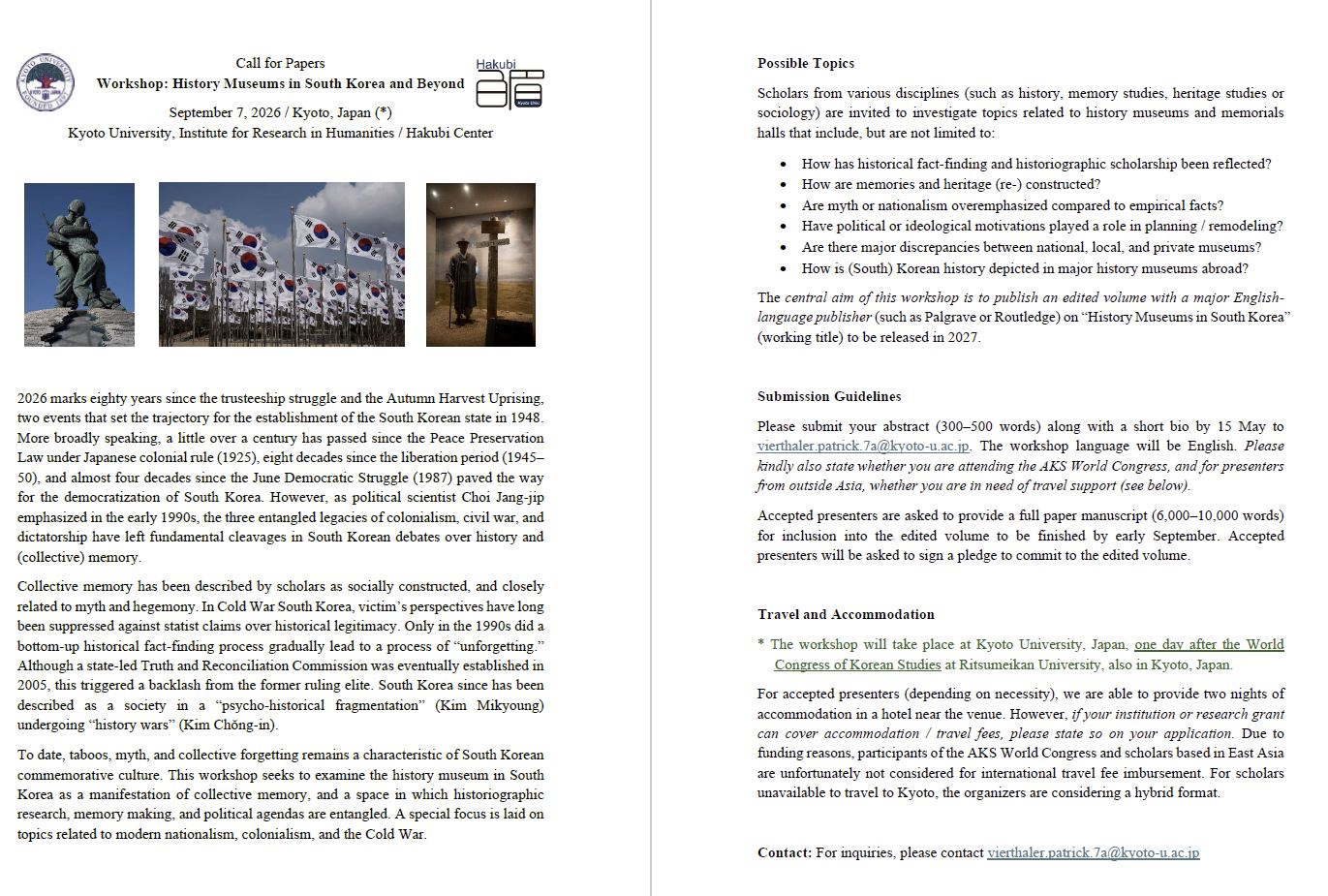
Call for Papers
History Museums in South Korea and Beyond
English
September 7, 2026 / Kyoto, Japan (*)
Kyoto University, Institute for Research in Humanities / Hakubi Center
2026 marks eighty years since the trusteeship struggle and the Autumn Harvest Uprising, two events that set the trajectory for the establishment of the South Korean state in 1948. More broadly speaking, a little over a century has passed since the Peace Preservation Law under Japanese colonial rule (1925), eight decades since the liberation period (1945–50), and almost four decades since the June Democratic Struggle (1987) paved the way for the democratization of South Korea. However, as political scientist Choi Jang-jip emphasized in the early 1990s, the three entangled legacies of colonialism, civil war, and dictatorship have left fundamental cleavages in South Korean debates over history and (collective) memory.
Collective memory has been described by scholars as socially constructed, and closely related to myth and hegemony. In Cold War South Korea, victim’s perspectives have long been suppressed against statist claims over historical legitimacy. Only in the 1990s did a bottom-up historical fact-finding process gradually lead to a process of “unforgetting.” Although a state-led Truth and Reconciliation Commission was eventually established in 2005, this triggered a backlash from the former ruling elite. South Korea since has been described as a society in a “psycho-historical fragmentation” (Kim Mikyoung) undergoing “history wars” (Kim Chŏng-in).
To date, taboos, myth, and collective forgetting remains a characteristic of South Korean commemorative culture. This workshop seeks to examine the history museum in South Korea as a manifestation of collective memory, and a space in which historiographic research, memory making, and political agendas are entangled. A special focus is laid on topics related to modern nationalism, colonialism, and the Cold War.
Possible Topics
Scholars from various disciplines (such as history, memory studies, heritage studies or sociology) are invited to investigate topics related to history museums and memorials halls that include, but are not limited to:
The central aim of this workshop is to publish an edited volume with a major English-language publisher (such as Palgrave or Routledge) on “History Museums in South Korea” (working title) to be released in 2027.
Submission Guidelines
Please submit your abstract (300–500 words) along with a short bio by 15 May to vierthaler.patrick.7a@kyoto-u.ac.jp.
The workshop language will be English.
Please kindly also state whether you are attending the AKS World Congress, and for presenters from outside Asia, whether you are in need of travel support (see below).
Accepted presenters are asked to provide a full paper manuscript (6,000–10,000 words) for inclusion into the edited volume to be finished by early September. Accepted presenters will be asked to sign a pledge to commit to the edited volume.
Travel and Accommodation
* The workshop will take place at Kyoto University, Japan, one day after the World Congress of Korean Studies at Ritsumeikan University, also in Kyoto, Japan.
For accepted presenters (depending on necessity), we are able to provide two nights of accommodation in a hotel near the venue. However, if your institution or research grant can cover accommodation / travel fees, please state so on your application. Due to funding reasons, participants of the AKS World Congress and scholars based in East Asia are unfortunately not considered for international travel fee imbursement. For scholars unavailable to travel to Kyoto, the organizers are considering a hybrid format.
Contact: For inquiries, please contact vierthaler.patrick.7a@kyoto-u.ac.jp